
Save It to Improve Your Life Before It’s Too Late!
December 25, 2025
Modern human life is too complicated to picture in single frame. It takes time to understand it & realize the links between all its aspects; it takes hard work & effort to improve ourselves & make meaningful changes. However, 2-things are certain:
- You cannot change everything.
- You are the one who can make the difference!

You are part of the environment that contains you
You cannot change this fact! Therefore, your actions as an individual are crucial, even the smallest ones, in protecting it. If you are not aware of this, that's ok - this post will help you to understand. But if you are ignoring it on purpose, this means you are not taking your responsibility towards the place you live in seriously. This often turns your presence into a negative impact on the environment, whereas our world desperately needs the opposite. So, be eco-friendly.
How to be positive?
There are countless actions you can take to create positive change in all areas of life. But in this post, we'll focus on one of the most pressing issues of our time—an environmental crisis—and explore how you can make your presence more beneficial. Small adjustments in your daily actions are all it takes.
Save it to save yourself!
Who hasn't heard about marine pollution? Or perhaps you know it better as plastic pollution. Remember that image of the poor whale, washed up on the beach with its mouth full of plastic waste? That was just one tragic result of marine pollution, which leads to many disastrous effects.
As humans, our environmental achievements are much more than that! But in this post, I will focus specifically on marine pollution and its various types. Then, we will see what simple changes we can make – as one – to help solve this problem. And the good news is that by doing so, you can improve your own life & health while contributing to a better world.

Don’t worry, this will cost you almost nothing. In fact, it might even lower the taxes you pay in the long run, as some countries allocate funds to combat and prevent marine pollution. So, let’s explore what we can do to heal the damage we've done to this planet.
Note: ‘you’, ‘we’, ‘us’, and ‘they’ in this post refers to ‘us’ as one society: individuals, groups such as manufactories, governments, and non-profit organizations.
I am not trying to blame anyone here, but to highlight the importance of our actions as one. We are all responsible in one way or another, therefore, only ‘together’ we can contain & minimize the negative effect of this critical crisis. What matters now is what we all should do, not who caused the problem.
What is marine pollution?
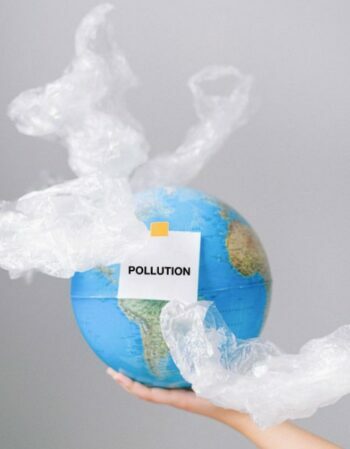
Marine pollution is one of the most critical issues facing the world today. Here is an academic definition from National Geographic Education (Source: Marine Pollution):
“Marine pollution is a combination of chemicals and trash, most of which comes from land sources and is washed or blown into the ocean. This pollution results in damage to the environment, to the health of all organisms, and to economic structures worldwide”.
In simple terms, when pollution enters water and makes its way to the ocean or a lake, it causes harm to marine life and the environment. Ultimately, this damage — mainly from our waste — will negatively impact our lives too, including yours!
How? Here is the answer…
Marine life is one of our primary sources of food and water, both for us and other creatures. Who doesn’t know that? So why do people still throw their trash in the water? I can’t comprehend it — they’re polluting the very resources they depend on! The water we swim in, which covers about two-thirds of our planet! Isn’t that selfish? They seem to care only about themselves and their pockets in the moment, not even thinking about their future!
Polluting what they consume, and what other creatures rely on, harms our health and can lead to long-term issues; after all, humans consume everything, even those creatures!
But this isn’t new—humans often remain careless until the damage accumulates and affects their own lives or becomes a widespread disaster. Don’t get me wrong; this doesn’t mean they’ll stop littering. No, they’ll just complain to the government, which is responsible for the environment, and that’s when it steps in.
How could taxes be relevant?
Many governments and non-profit organizations worldwide have taken responsibility for this ‘blind’ problem. Why ‘blind’? Because these polluters not only contaminate the waters but also force governments and others to spend $Billions just to manage the situation, especially in coastal countries. So, ‘Blind’ refers to those who are either ignorant or simply careless, choosing to ignore reality by covering their eyes and ears.
Sometimes, when we’re angry, we might throw things around—it happens. Just remember to clean up your mess once you’ve calmed down.
Why?
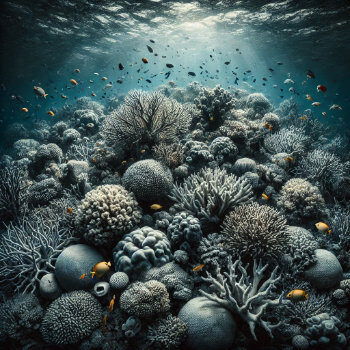
According to World Economic Forum:
“The world has lost 14% of its coral reefs since 2009, an area larger than the entire Great Barrier Reef, and current projections highlight the risk of 90% of the world’s remaining coral reefs disappearing by 2050.
“Despite being a cornerstone of ocean health and climate resilience, the existence of these critical ecosystems is at stake due to the climate crisis and human-driven threats including destructive fishing and tourism, agricultural run-off, sewage pollution & plastic pollution.
“The Coral Reef Breakthrough calls for investments of $12 billion by 2030 from public and private sources to safeguard the future of drastically underfunded coral reefs.
For more in-depth information about coral reefs, check out the full post at the following link: The Coral Reef
Did you get it?
Yes, they’re spending the taxes we all pay—your money. We are the source of that revenue, through our hard work. So, take care of the planet that contains you! Doing so will ease the financial burden on both your wallet and future generations. This is another reason NOT to pollute marine life & to help save the planet. It is so easy to do, in case you care.
What other negative effects can marine pollution cause?
Now that we’ve seen how marine pollution negatively affects our health, economy, and environment, let’s see its impact on society.
If you’re someone who cares about the place you live in, here are a few questions:
- Would you feel like you belong in a place where people consume and damage everything around them?
- What would that place look like?
- How strong would your relationship be with those people?
- Do they respect you and your presence by ignoring your right to live in a clean environment?
- How would it feel to see someone littering while you, as a volunteer, work to keep the area clean? I think the answers will be more negative than positive. And it is normal as a result of the social impact.
I think the answers will lean more negative than positive, which is a typical outcome of social impact.
Our daily actions influence the strength of our society. Volunteering and working together fosters a sense of belonging and helps build personal relationships. Conversely, negative actions have the opposite effect. There's no doubt that marine pollution affects our society as well, since it stems from our collective behavior as one community.
Summing-Up
Now, let’s put everything together: health, economy, environment, society, and government. Does this ring a bell? If not, let me help you— together, they make up the Quality of Life.
Definition: “Quality of life (well-being) refers to the wealth and comfort of individuals, communities and society based on both material and non-material factors that are important to people’s lives, such as health and social connections.
For details, check the source: Statistics Canada – Quality of Life Hub
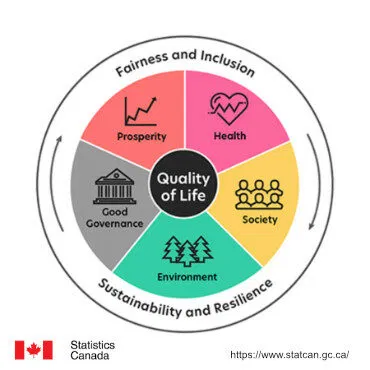
So, putting everything together reveals that…
Marine pollution, a consequence of our actions, diminishes our quality of life
Did you know that?
Your actions either build or harm the place you live in, along with its environment
Even the government is made up of people elected by your vote—your action. While this isn’t the case in every country, let’s focus on the point here.
Now that we’ve seen how severely marine pollution damages our quality of life, let’s dive deeper into this crisis and view it through a Deep Picture.
As I mentioned before, marine pollution occurs when harmful ‘things’ enter the water. There are several types of pollutions, but they can be grouped into 3-major causes: substance, invasive organisms, & noise!
Take a look…
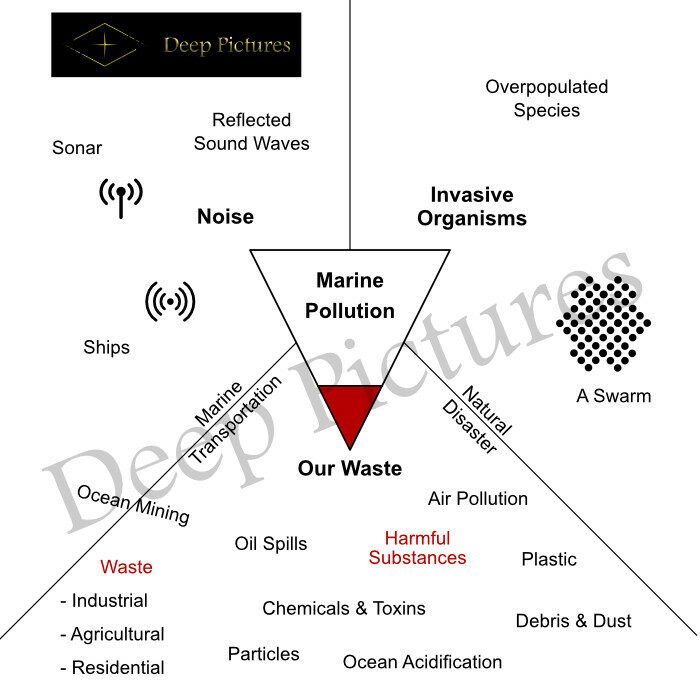
From this image, we can see the core causes of marine pollution. First, I’ll explain the 3-main groups, and then I’ll briefly discuss a few types. If you're interested in more information about the different types of pollution, check the source link: (Wikipedia - Marine pollution).
Underwater noise
“It is from sources such as passing ships, oil exploration seismic surveys (reflected sound waves tech), & naval sonar. This noise disrupts the mechanical waves (acoustic) used between the marine animals to communicate & explore the surrounding area, which makes species communicate louder! If creatures don’t “speak” loud enough, their voice can be masked by anthropogenic sounds (human-generated sounds). These unheard voices might be warnings, findings of prey, or preparations of net-bubbling (a feeding behavior of some whales).
“Sound travels more rapidly & over larger distances in the sea than in the atmosphere. When one species starts communicating louder, it will mask other species voices, causing the whole ecosystem to eventually speak louder. Source: Wikipedia - Marine pollution
Invasive Organisms
“It is a species living outside its native distributional range, but which has arrived there by human activity, directly or indirectly, & either deliberately or accidentally; that becomes overpopulated and harms its new environment.
“Invasive species adversely affect habitats & bioregions, causing ecological, environmental, and/or economic damage. The term can also be used for native species that become harmful to their native environment after human alterations to its food web.
Sources: Introduced species; Invasive species
The Core Cause: Harmful Substances – Our Waste!
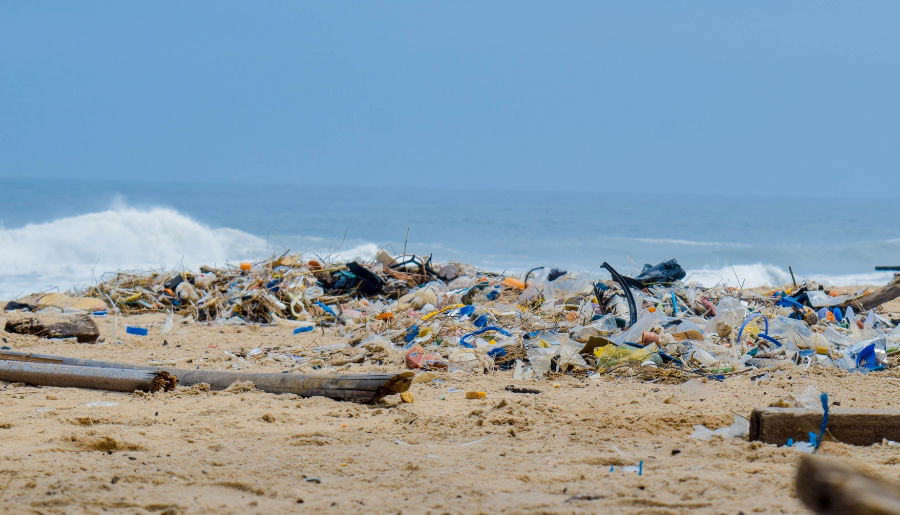
“80% of the waste comes from land-based activity, although marine transportation significantly contributes as well. This pollution results in damage to the environment, to the health of all organisms, and to economic structures worldwide.
“Air pollution is also a contributing factor by carrying off iron, carbonic acid, nitrogen, silicon, sulfur, pesticides or dust particles into the ocean. The pollution often comes from nonpoint sources such as agricultural runoff, wind-blown debris, and dust.
“Ocean acidification is the decrease in the pH of the Earth’s Ocean.
“Toxicants: apart from plastics, there are particular problems with other toxic pollutants that either do not break down or only very slowly in the marine environment such as pesticides. Heavy metals are metallic chemical elements that have a relatively high density and are toxic or poisonous at low concentrations. Examples are mercury, lead, copper & cadmium. Source: Marine pollution
All these types of pollution reach the oceans through rivers, runoff, winds, and, of course, our actions. If we improve our behavior and keep our lands free from harmful substances, it will ease the burden on governments and non-profit organizations tackling pollution. By supporting water clean-up efforts, you help prevent the situation from worsening. So, be mindful of your actions!
How?
Here are some guidelines you can follow to improve your impact on the environment as an individual:
- First and foremost, dispose of trash properly. It’s simple and clear—there’s nothing more to explain.
- Improving the quality of our waste reduces environmental damage. Try to buy eco-friendly products whenever possible; it’s crucial.
- Choosing organic food means less demand from farming substances that can end up in water.
- Minimize plastic use, or avoid it altogether.
- Boycott companies that carelessly pollute the environment without taking responsibility.
- Keep areas clean to prevent waste from being carried into water sources by wind or floods.
- Engage in volunteer work like cleaning shores or collecting trash while diving.
- Intercepting plastic in rivers is effective and accessible—if you can, why not do it?
- Support or donate to organizations addressing this crisis.
Here are a few more in a nice infographic image I found at Oceanservice.noaa.gov. Check the link for more details:
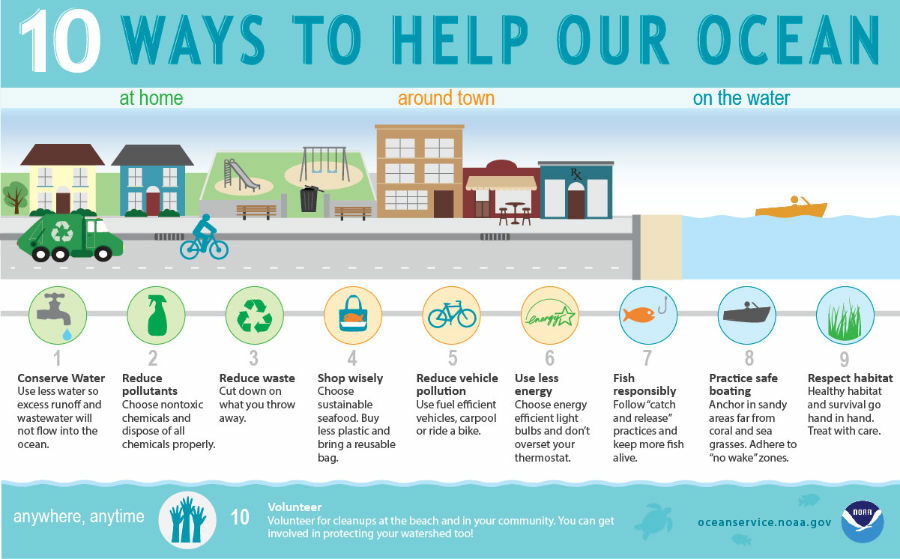
In short, any action that can ‘Undo’ a cause of pollution will help solve the problem. So, be mindful of your actions, even the small ones; every drop of positive effort counts. We are already more than 8-billion individuals on this planet; 8-billion drops can make a huge impact! Think of it that way.
Remember, change takes time
Changes happen gradually over time. As individuals and in groups, we need time to adapt to new changes. Adapting involves gradually altering our habits, management, and political systems. Sudden changes can lead to significant losses or even bankruptcy. Some reasons for this could include:
- The high costs of eco-friendly waste processing methods
- Stockpiled inventory in warehouses and stores that need time to be sold
- Job losses in the market, leading to increased unemployment—people have financial obligations to meet
- Governments require time and significant funds to change systems and develop new strategies
- In some cases, when no alternatives are available, change isn't possible yet.
It's all about time and positive actions. We can't heal the environment overnight, but we can do it together. All you need to do is improve your actions and give yourself time to adapt, regardless of what others do. Right?
What do you think about all of this?
Share your thoughts in the comments section of the post on social media. Your words could make a difference, So try to engage. Likes and shares are appreciated too.
Thanks For Reading
Goodbye Till Next Post