
Understanding the Causes of Cancer
January 1, 2026
Cancer is a real and growing threat to humankind. While no one can eliminate the risk entirely, the most effective way to deal with cancer is to reduce that risk as much as possible—and that begins with knowledge.
In this post, I will share some of the causes of cancer. However, the most important and fundamental causes are explored in depth in a separate, main article I previously published about cancer.
Before examining the additional causes discussed here, it’s essential to first develop a clear and simple understanding of what cancer is, what truly causes it, and how its risk can be reduced. In that main post, you’ll also encounter a unique analogy that compares our everyday behaviors to the behavior of our own cells—including cancer cells. It offers a fresh perspective that helps make a complex topic easier to understand.
This post is a continuation of that foundational article, which I strongly recommend reading first. You can find it at the link below:
Assuming you’ve finished the previous post, let’s move on...
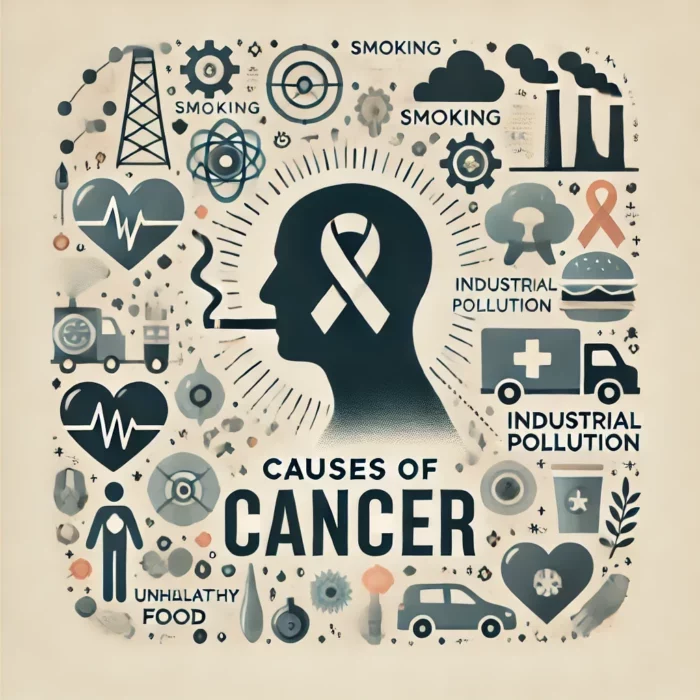
You’ve likely heard about various causes of cancer, such as smoking, sun exposure, poor diet, an unhealthy lifestyle, physical inactivity, or being overweight. But do you really understand what happens with each of these causes and how they ultimately lead to cancer? This post will address each of these points.
However, …
Since healthcare is not my area of expertise, most of the content here is quoted from different trusted sources. I've provided a brief overview of each cause without delving into too many details. If you’d like to explore any of these causes further, you can refer to the relevant sources linked below each section.
Let’s begin with the first cause
Physical agents – asbestos
“Some substances cause cancer primarily through their physical, rather than chemical, effects. Usually, physical carcinogens must get inside the body (such as through inhalation) and require years of exposure to produce cancer.
Source: https://en.wikipedia.org/wiki/Cancer
“A prominent example of this is prolonged exposure to asbestos - it is a primary cause of mesothelioma, a rare form of cancer that develops on the linings of the lungs and abdomen. It can also lead to lung cancer, laryngeal cancer and ovarian cancer.
“Asbestos causes cancer through inflammation and cell damage over many years. This unique mineral contains flexible fibers that can separate. The fibers become stuck within sensitive tissue around the lungs or abdomen if inhaled or ingested. As the fibers damage DNA over time, the genetic changes lead to abnormal cell growth and cancer.
Source: Asbestos.com - Asbestos Cancer
Chemical Agents
Chemical agents can enter the body through breathing, ingestion, skin absorption, or other forms of intake. Here are some examples:
- Diet: contaminated or junk food, poor water quality, low-quality supplements, etc.
- Air Pollution
- Chemical exposures at work
- Smoking = inflammation
“Many of its chemicals can damage your DNA, which controls how your body makes new cells and directs each kind of cell to do what it is made for. Damaged DNA can make cells grow differently from how they are supposed to. These unusual cells can turn into cancer.
Source: CDC - Tobacco and Cancer
Alcohol
It can cause cancer by:
- “Ethanol (pure alcohol) and its toxic by-product acetaldehyde damaging cells by binding with DNA and causing cells to replicate incorrectly.
- “Influencing hormone levels, which can modify how cells grow and divide.
- “Direct tissue damage, increasing the absorption of other carcinogens.
Source: Cancer Council Victoria - How alcohol causes cancer
Radiation exposure
It can come from sources such as natural (e.g., UV rays from the sun), industrial, and medical (e.g., CT scans).
“Too much UV radiation from the sun or sunbeds can damage the DNA in our skin cells. DNA tells our cells how to function. If enough DNA damage builds up over time, it can cause cells to grow out of control, which can lead to skin cancer. Anyone can develop skin cancer. Some people may have a higher risk, including people who burn more easily.
Source: Cancer Research UK - How does the sun and UV cause cancer?
Infections
“An infection is the invasion of tissues by pathogens, their multiplication, and the reaction of host tissues to the infectious agent and the toxins they produce.
Source: Wikipedia - Infection
“It can cause certain cancers in a variety of ways including by affecting the genes in your cells, by causing inflammation in your body, or by affecting how your immune system works.
Source: National Academies - Is there a link between infections and cancer?
“Poor water quality is associated mainly with infectious diseases.
Source: https://www.ncbi.nlm.nih.gov/books/NBK54025/
“Certain infectious agents, including viruses, bacteria, and parasites, can cause cancer or increase the risk that cancer will form. Some viruses can disrupt signaling that normally keeps cell growth and proliferation in check. Also, some infections weaken the immune system, making the body less able to fight off other cancer-causing infections. And some viruses, bacteria, and parasites also cause chronic inflammation, which may lead to cancer.
How can you lower your risk of infection?
For more details, check the source: National Cancer Institute - Infectious Agents
Inflammations
“In a normal inflammatory response, immune cells produce chemicals that can kill a pathogen. These chemicals, known as reactive oxygen species, can also damage the DNA of normal cells. When these inflammatory responses become chronic, cell mutation and proliferation can result, often creating an environment that is conducive to the development of cancer.
Source: NIH - Inflammation and Cancer.
NIH - Targeting Inflammation Emerges as a Strategy for Treating Cancer
Here is a common cause to inflammation:
Obesity: “Overweight and obesity can cause changes in the body including long-lasting inflammation and higher than normal levels of insulin, insulin-like growth factor, and sex hormones. These changes may lead to cancer. The risk of cancer increases with the more excess weight a person gains and the longer a person is overweight.
Source: CDC - Obesity and Cancer
Immunosuppression
“The body’s immune response plays a role in defending the body against cancer, a concept known mainly because certain cancers occur at a greatly increased prevalence among people whose immune systems are suppressed persistently. Medical drugs and certain infections are the most frequent immunosuppressants.
Source: NIH - Immunosuppression
Autoimmune diseases
“There is an association between celiac disease and an increased risk of all cancers. People with untreated celiac disease have a higher risk, but this risk decreases with time after diagnosis and strict treatment. This may be due to the adoption of a gluten-free diet, which seems to have a protective role against development of malignancy in people with celiac disease. However, the delay in diagnosis and initiation of a gluten-free diet seems to increase the risk of malignancies.[94] Rates of gastrointestinal cancers are increased in people with Crohn's disease and ulcerative colitis, due to chronic inflammation. Immunomodulators and biologic agents used to treat these diseases may promote developing extra-intestinal malignancies.
Ending...
I hope this post was helpful and added clarity to your understanding of the causes of cancer, so you can take informed steps to reduce its risk. As I mentioned earlier, this is not my field of professional expertise, which is why I’ve limited the discussion to the most relevant causes I could confidently present.
My goal across these two posts was to gather and synthesize as much reliable information as possible, offering a big-picture view of cancer without diving into overly technical or complex details. While there may be additional causes I did not cover, the purpose was never to be exhaustive.
Instead, my main aim was to share a different perspective—using a biological analogy—to help people better understand cancer, encourage healthier choices that reduce risk, and, perhaps, inspire researchers and scientists to look at the problem from a fresh angle on the path toward a cure.
Ultimately, awareness is one of the strongest tools we have. The more clearly we understand how our choices affect our bodies at the cellular level, the more power we gain to protect our health. If this perspective encourages even small, positive changes—or sparks new ways of thinking—then this work has served its purpose.